Crossflow Cooling Tower Guide: How It Works and When to Choose It
A crossflow cooling tower moves air horizontally across falling water, which keeps fill, distribution and drift eliminators accessible from outside the casing. This guide explains how the arrangement works, how it differs from counterflow, and what to check when selecting.
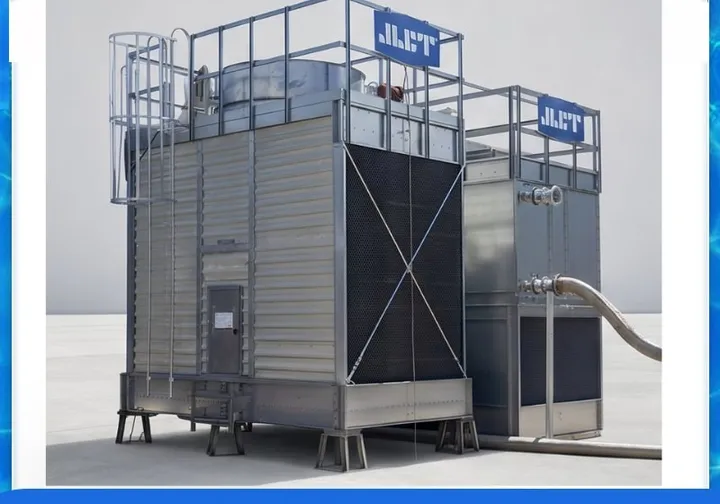
What a Crossflow Cooling Tower Is and When It Fits
A crossflow cooling tower is a tower in which air moves horizontally across water that falls through the fill. Hot water reaches a basin above the fill and spreads across the fill face by gravity, then meets air drawn through the full-height inlet opening by an induced-draft fan at the top. Because the air path is sideways rather than upward, the fill stays shallow and the water pattern remains visible from outside the casing.
Running a cross flow cooling tower is largely a matter of water distribution. Water leaves the hot basin through weirs or large-orifice openings, films or splashes down the fill, and drops into the cold-water basin below. Air enters across the whole inlet face, crosses the falling water and leaves through drift eliminators, which catch entrained droplets before the fan discharges the air upward. The horizontal path exposes the distribution troughs and the fill surface for routine inspection.
Choose the arrangement when access and layout matter more than a tight footprint. Crossflow suits sites with room to the sides, roofs where a low profile helps, and commercial buildings where crews should reach the fill and distribution without entering the casing. Jinling builds the JNT series cross-flow open cooling tower, which is listed with CTI certification code C28A-05R08; the range is set out under FRP cooling towers.
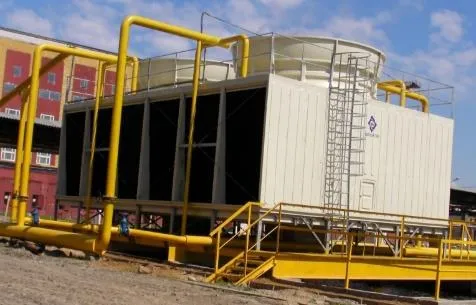
Rectangular tower with side intakes and yellow pipework 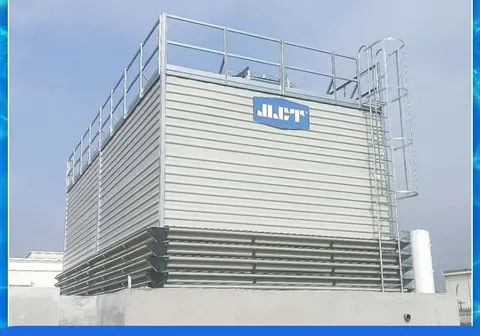
Rectangular tower with low intake louvers
Counterflow Cooling Towers
A counterflow cooling tower pulls air upward through the fill while water falls downward, so the streams travel in opposite directions. Water is sprayed from nozzles above the fill, passes through film or splash fill, and collects in a cold-water basin at the base, while an induced-draft fan draws air in around the base and discharges it at the top. The vertical arrangement keeps the plan area compact, and a counter flow cooling tower usually occupies a smaller footprint than a crossflow tower of similar duty.
An induced draft counterflow cooling tower places the fan above the drift eliminators at the air outlet, with the spray distribution deck above the fill. Air rises through the fill against the falling water, which keeps a more even temperature difference between the streams along the fill depth. The spray nozzles add head to the pump duty, so pumping energy can be higher than with gravity-fed distribution, and nozzles need clean water and routine attention.
Jinling builds counter-flow towers as open and closed circuit units. The JFT counter-flow open cooling tower has passed CTI certification, and the JFC counter-flow closed circuit cooling tower is listed with CTI certification code C28D-24R00. The closed unit adds a coil, so process water stays inside a tube bundle and does not meet the air directly.
Crossflow vs Counterflow Cooling Towers
The central difference between a crossflow and a counterflow tower is the direction of the air. Crossflow air crosses the falling water horizontally through a full-height inlet face; counterflow air rises vertically against the falling water. Fill orientation, footprint, maintenance access and fan position all follow from that geometry.
- Airflow: horizontal across the fill in crossflow, vertical upward through the fill in counterflow.
- Fill orientation: crossflow fill follows a tall inlet face, while counterflow fill sits in horizontal layers beneath the spray deck.
- Footprint: crossflow towers are usually wider and lower, counterflow towers taller with a smaller plan area.
- Maintenance access: an open crossflow inlet face exposes fill and distribution troughs; counterflow towers are reached from above or through casing panels.
- Fan arrangement: induced draft is common in both, with the fan at the air outlet.
- Typical use: crossflow where side room and inspection access matter, counterflow where the plan area is constrained.
JLCT traces its origins to 1983 in Zhuji City, Zhejiang Province, and Jinling now produces cross-flow and counter-flow series. The JNT cross-flow open cooling tower is listed with CTI certification code C28A-05R08, and the JFT counter-flow open cooling tower has passed CTI certification. Each is an open tower, so the choice comes down to layout, access and the heat load to be rejected; see FRP cooling towers for the series.
Crossflow Cooling Tower Design
Design of a crossflow cooling tower follows the water path first. Hot water enters a distribution basin along the top of the fill and drops through large-orifice openings or weirs, spreading across the fill by gravity instead of pumped spray pressure. The fill stands in a thin layer along the inlet face, drift eliminators sit on the air-outlet side, the casing and frame carry the structure, and the cold-water basin collects the cooled water. An induced-draft fan on top pulls air through the whole inlet face.
Cross flow cooling tower design work then matches the unit to the duty and the site. Water flow rate, hot and cold water temperatures, range, approach and design wet-bulb temperature set the fill volume; water quality points to splash fill, which tolerates dirtier water but needs a larger structure, or to film fill; and available footprint, height limits and redundancy shape the cell arrangement. Final selection is confirmed against project conditions in the quotation.
- Water flow rate, hot water temperature and cold water temperature.
- Range and approach, with the design wet-bulb temperature for the site.
- Water quality, which points to splash fill or film fill.
- Available footprint, height limit and lifting access.
- Redundancy and cell arrangement for the operating profile.
The fill, drift eliminators and spray nozzles are the components most often inspected or replaced over a tower’s working life, and access to them is the practical reward of the open inlet face described here. Spare and replacement parts are grouped under cooling tower parts.
Airflow Patterns Compared
Parallel flow, counter flow and cross flow describe how air and water meet inside a heat and mass transfer device. In parallel flow, air and water travel in the same direction, so the streams converge in temperature and the driving force falls away along the path. In counter flow, they travel in opposite directions, which keeps a more even temperature difference along the fill. In cross flow, they meet at right angles.
Cooling towers commonly use crossflow or counterflow arrangements, and parallel flow is rarely used for evaporative heat rejection because it gives up the available temperature difference. Splash fill appears in crossflow towers, where the full-height inlet face lets an inspector watch the water pattern and the condition of the fill. Towers may also be forced draft or induced draft, and open or closed circuit, which changes how water is contained rather than the flow geometry.
Request a quotation
Describe your cooling load, water temperatures and site, and we will suggest matching JLCT towers.
Or write to sales@coolingtowerfactory.com