Data Center Cooling Tower Guide: Types, Selection and Heat Rejection
Data centers reject heat through water, and the tower that does the rejecting shapes water use, noise and reliability. This guide covers data center cooling tower types, airflow choices and selection factors, with the JLCT range from Zhuji, Zhejiang as the reference.
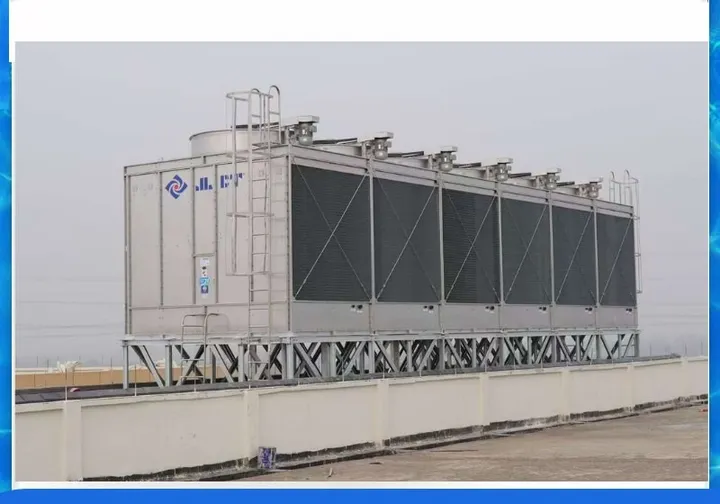
Data Center Cooling Tower Guide: Types, Selection and Heat Rejection
A data center cooling tower is the heat-rejection device that takes warmth out of a water-cooled system and gives it to the atmosphere. On a data center site it serves the chiller plant or the water-cooled loop that carries server heat away, so the heat leaves the building in evaporated water rather than in condenser air. That rejection runs continuously, which puts the tower in the critical cooling path: when heat rejection falls short, supply temperatures climb and IT load has to be managed.
Tower circuits come in open and closed form. An open circuit tower exposes water to air directly, so the water that cools the plant is the water that evaporates, and open-circuit performance follows the wet-bulb temperature. A closed circuit tower keeps the process fluid inside a coil and sprays separate water over the outside, so the loop stays clean; in wet operation the entering wet-bulb temperature still sets performance, and dry-bulb temperature matters when the coil runs dry. Airflow is a separate decision: cross-flow towers pass air horizontally through falling water, counter-flow towers pass air upward against it, and the choice changes footprint, pressure loss and service access.
- Fill spreads water into film or splash sheets so air meets more surface inside a smaller casing.
- Drift eliminators catch droplets carried in the exhaust air and return them to the basin.
- Spray nozzles spread hot water evenly over the fill; blocked or worn nozzles cost thermal margin.
- Approach and range describe what the tower can hold at a given wet-bulb temperature.
- Casing and fan materials, from FRP to galvanized or stainless steel, suit different water and weather.
Jinling manufactures cooling towers under the JLCT brand. The JLCT business traces its origins to 1983 in Zhuji City, Zhejiang Province, China, and more than 40 years of work has taken it into cooling towers and refrigeration equipment. The series include the JNT cross-flow open tower, the JFT counter-flow open tower, the JNC and JFC closed circuit towers and the JBN large industrial tower. The JNT series is listed with CTI certification code C28A-05R08, the JNC closed circuit tower C28B-09R02 and the JFC closed circuit tower C28D-24R00, and the JFT tower has passed CTI certification.
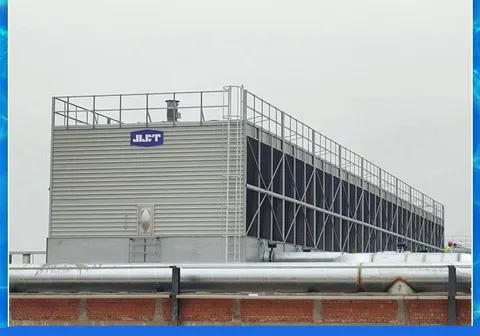
Long tower bank behind rooftop piping 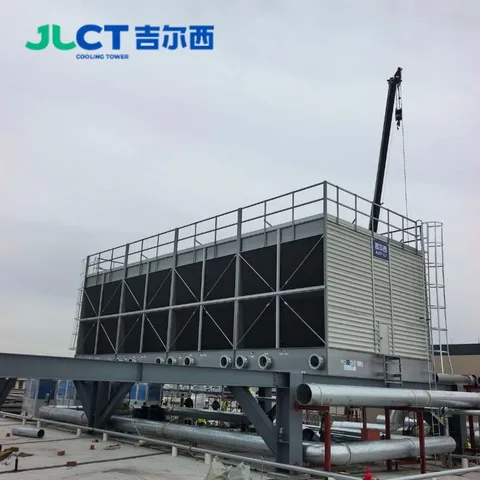
Elevated tower bank with crane behind
Cooling Towers for Data Centers
Data centers ask more of a tower than most buildings do. Heat rejection runs all year and rarely halts, so basins, strainers and fan drives have to stay serviceable while the hall is live. Duty is met with multi-cell or modular layouts, which let the plant stage towers as load moves instead of running everything at part capacity. Sites near housing need low-noise fans and discharge arrangements, coastal and industrial sites need corrosion-resistant construction, and a tight water budget favours closed circuit designs.
- Continuous duty: basin, strainer and fan-drive access that works while the hall runs.
- Layout: multi-cell or modular arrangements that support staged operation and part-load efficiency.
- Acoustics: fan type, speed and discharge direction chosen against the site noise limit.
- Materials: FRP, galvanized or stainless steel to suit water chemistry and airborne salt.
- Water: closed circuit designs where a clean process loop matters.
Selection starts from flow rate, water temperatures, wet-bulb temperature and site conditions, and the selection factors below show how those inputs steer the choice between open and closed circuits and between cross-flow and counter-flow airflow, explained further in the airflow comparison guide. Requests outside the range go to the inquiry form.
Selection Factors for Data Center Heat Rejection
Selection starts with the water: design flow rate, entering and leaving water temperatures, and the wet-bulb temperature the site reaches in summer. Flow and temperature drop set the range, while the wet-bulb temperature and the approach the plant can accept set the leaving water temperature a tower can hold. The site then settles the rest: footprint and structural support, the noise limit at the nearest sensitive point, plume and drift expectations, water chemistry, and the access crews need around the basin and fan deck.
- Design flow rate and water temperatures from the chiller plant or water-cooled loop
- Wet-bulb temperature and the approach the plant can accept
- Site noise limit and the distance to the nearest sensitive point
- Water chemistry, make-up water and blowdown plan
- Footprint, structural support and lifting access during installation
Send the flow rate, water temperatures, wet-bulb temperature and site conditions, and JLCT works through tower selection and a quotation, then production, packing and shipping. Payment by L/C and T/T is accepted, and terms are confirmed in the quotation. Typical lead time is around a month in peak and off seasons, confirmed per order. Towers carry a warranty of 12 months after commissioning or 18 months after shipment, whichever comes earlier, except for artificial damage.
Water Use, Heat Loads and Service Access in Operating Halls
Open-loop towers cool warm water from servers by direct contact with air, and the evaporation that removes heat efficiently also consumes water continuously, which is why the method is common in large data centers. Industry-average Water Usage Effectiveness has been reported around 1.8 liters per kWh. An International Energy Agency study estimates that a 100 MW U.S. data center may use roughly 530,000 gallons of water per day across cooling strategies, with 725,000 liters (roughly 190,000 gallons) per day consumed on site, a little less than 40%.
Water treatment protects that budget. In the FEMP best-practice example, raising the cycles of concentration from three to six cuts cooling tower makeup water by 20% and blowdown by 50%, so a programme that keeps scale and corrosion in check saves water as well as tube life. Condenser flow follows the load: in one cited design example for a data center of one megawatt, the tower handles 855 gallons of condenser water per minute, on a design flow of 3 gallons per minute per ton.
Service planning keeps a live hall online. The JNT, JFT and JNC/JFC series hold energy-saving and water-saving certifications from the China Quality Certification Center, and Jinling holds ISO 9001, ISO 14001 and ISO 45001 certificates, with the CTI codes set out on the certifications page.
Request a quotation
Describe your cooling load, water temperatures and site, and we will suggest matching JLCT towers.
Or write to sales@coolingtowerfactory.com