Evaporative Cooling Tower: How Wet Towers Reject Heat
An evaporative cooling tower rejects heat from a water-cooled chiller plant by evaporating a small share of the condenser water into moving air. This guide explains the mechanism, the draft arrangements and the choices that shape a wet tower selection.
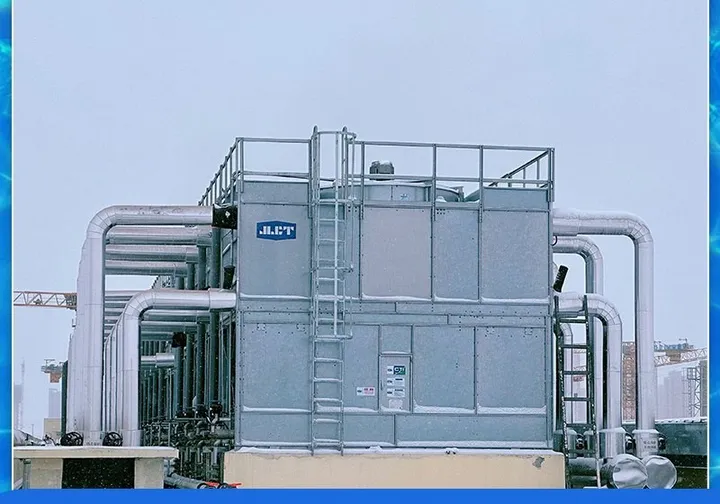
What an Evaporative Cooling Tower Is and How It Works
An evaporative cooling tower is a wet heat-rejection device used with water-cooled chiller plants. The chiller condenser transfers its heat to condenser water, and the tower rejects that heat to outdoor air, mainly through evaporation. Because the process relies on moving air and wetted fill rather than a sealed refrigerant circuit, leaving water temperature follows the outdoor wet-bulb temperature. The sections below cover placement in a chiller plant, evaporative cooling, induced versus forced draft, and how a cooling tower cools water.
‘Evap cooling tower’ is a shortened term for an evaporative cooling tower, not a different product type, and the same wet heat-rejection principle applies under either name. What changes between installations is the circuit arrangement, the airflow direction and the fill, not the physics. The working-principle sections below explain the mechanism, and the selection notes at the end set out the inputs Jinling needs to size a tower for a specific duty.
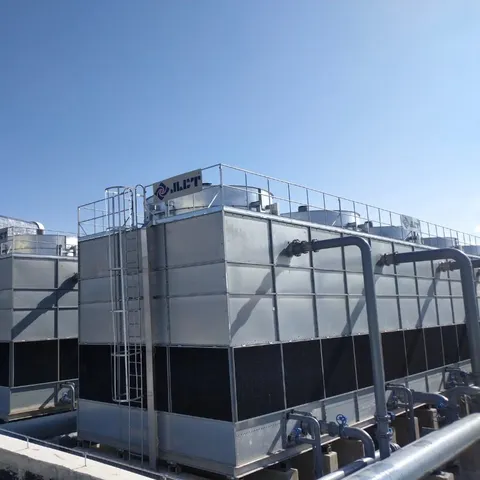
Outdoor tower bank with surrounding site piping 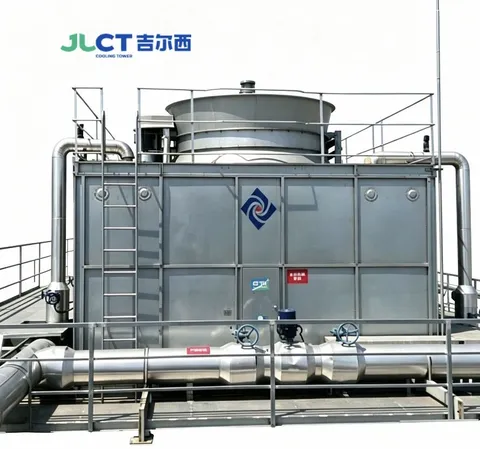
Installed tower with fan cowl and piping
Where an Evaporative Cooling Tower Fits in a Chiller Plant
In a water-cooled chiller plant the condenser rejects heat to condenser water, and an evaporative cooling tower rejects that heat to outdoor air. The tower is the heat sink of the plant, not a source of comfort cooling inside the building. Its position affects piping runs, pump head, available airflow and the route of the exhaust plume past the building envelope. Towers stand on roofs, in plant yards or on grade, subject to structural support, recirculation and the noise limit for the site.
Open towers distribute water directly over fill, where it contacts outdoor air. Closed circuit towers pass the process fluid through a coil and keep it separate from the atmosphere, with spray water over the coil providing the evaporative cooling. Jinling builds the JNT cross-flow open tower, the JFT counter-flow open tower, the JNC and JFC closed circuit towers and the JBN large industrial tower. Heavier process duty sits with the industrial cooling towers range, while building plants are covered on the commercial cooling towers page.
How a Cooling Tower Cools Water
Water is distributed over the fill as a film or as droplets, and air moves through the same volume. Part of the water evaporates into that air, and evaporation takes latent heat from the remaining water, so the bulk water leaves the tower cooler than it entered. Most of the cooling comes from evaporation rather than from air simply warming up. Drift eliminators catch droplets carried with the exhaust air and return them to the basin.
A cooling tower cools circulating water; it does not cool the occupied space directly. In a chiller plant the tower rejects condenser heat to outdoor air, while the chilled water that serves the building is cooled separately in the evaporator. Tower performance is judged on entering and leaving water temperatures against the wet-bulb temperature, and indoor comfort is judged on dry-bulb temperature and humidity. The tower loop and the indoor loop meet only through the refrigeration cycle.
The water that evaporates leaves the circuit and must be replaced. Make-up water covers evaporation, drift, blowdown and any leaks or overflows, and as a rule of thumb, for every 10°F (5.5°C) of water cooling, 1% of the total water mass is lost to evaporation. Blowdown controls dissolved solids in the basin, and in the FEMP best-practice example, raising cycles of concentration from three to six cuts make-up demand by 20% and blowdown by 50%.
Evaporative Cooling in Cooling Tower Operation
Evaporative cooling in a cooling tower is the latent-heat exchange that cools the circulating water, and it does most of the work in a wet tower. Sensible cooling, where air absorbs heat and rises in temperature, contributes a smaller share. How much moisture the air can still take up sets the limit, which is why wet-bulb temperature rather than dry-bulb temperature governs tower performance. Fill geometry, airflow and water distribution decide how much wetted surface does useful work.
Range is the drop in water temperature across the tower; approach is how close the leaving water temperature comes to the entering wet-bulb temperature. A tighter approach calls for more fill and more airflow. Drift elimination, fill type and spray pattern are chosen together so the tower rejects its design duty without throwing water past the eliminators. Evaporation loss is usually estimated from circulation rate, temperature drop and a small evaporation factor, then confirmed against the heat balance of the tower.
Induced and Forced Draft Cooling Towers
An induced draft cooling tower puts the fan at the air outlet, so the fan pulls air through the fill while water falls through it. The casing runs under slight negative pressure, and air enters through the inlet louvers and crosses the wetted surfaces, promoting evaporation and heat rejection. Induced draft suits most HVAC and industrial heat-rejection duties, with airflow spread across the fill area and exhaust directed upward, away from occupied areas and nearby intakes.
A forced draft cooling tower puts the fan at the air inlet and pushes air into the casing and through the fill. The plenum runs under positive pressure, so air can escape through joints and access doors, and the fan handles denser ambient air. Choosing between induced and forced draft is a selection question, not a promise of a result: size the tower for the duty, then confirm fan access, recirculation risk and the site noise limit. Jinling’s open and closed circuit towers are built in cross-flow and counter-flow layouts, and the crossflow vs counterflow guide explains how fill orientation changes footprint and maintenance routine.
Matching a Wet Tower to Load, Water and Site
Zhejiang Jinling Refrigeration Engineering Co., Ltd. sells its cooling towers under the JLCT brand, and JLCT traces its origins to 1983 in Zhuji City, Zhejiang Province, China. More than 40 years of work have made it a manufacturer of cooling towers and refrigeration equipment. CTI certification code C28A-05R08 covers the JNT cross-flow open cooling tower, C28B-09R02 covers the JNC cross-flow closed circuit cooling tower and C28D-24R00 covers the JFC counter-flow closed circuit cooling tower; the JFT counter-flow open cooling tower has passed CTI certification, and the JNT series has passed CTI annual testing for 21 consecutive years.
- Flow rate and the required entering and leaving water temperatures
- Design wet-bulb temperature and the conditions around the tower
- Open or closed circuit, and cross-flow or counter-flow layout
- Water quality, which guides fill, drift eliminator and spray nozzle choice
- Structural support, available airflow, noise limit and piping route
Jinling confirms the selection against that duty and quotes the tower. Payment is accepted by L/C and T/T, and average lead time is about a month in peak and off season; the lead time for a specific order is confirmed in the quotation. The warranty is 12 months after commissioning or 18 months after shipment, whichever comes first, except for artificial damage. Send the duty through the inquiry form to start the selection.
ISO 9001, ISO 14001 and ISO 45001 certificates sit alongside CCTI and CE certificates, and inspection reports cover the JNT, JFT, JNC and JFC series. Jinling is a national high-tech enterprise and is designated the Zhejiang Provincial Cooling Technology Enterprise Research Institute. Products reach more than 300 cities across China and are exported to more than 50 countries and regions, with main markets in North America, South America, Southeast Asia, the Middle East and China. See certifications.
Request a quotation
Describe your cooling load, water temperatures and site, and we will suggest matching JLCT towers.
Or write to sales@coolingtowerfactory.com